Assessment preparation platform for commercial airline pilots
An airline assessment day tests sequence recall, tracking, and arithmetic under a clock, and no flying school teaches them. Flight Deck IQ, ZingZee's own product, takes a candidate from first study module to timed mock, written with an assessor and a pilot who has passed it.
- Client
- Flight Deck IQ, ZingZee's own product for commercial pilots preparing for airline assessment days.
- Sector
- Product
- Headline result
- 500+ practice questions in the first module
At a glance
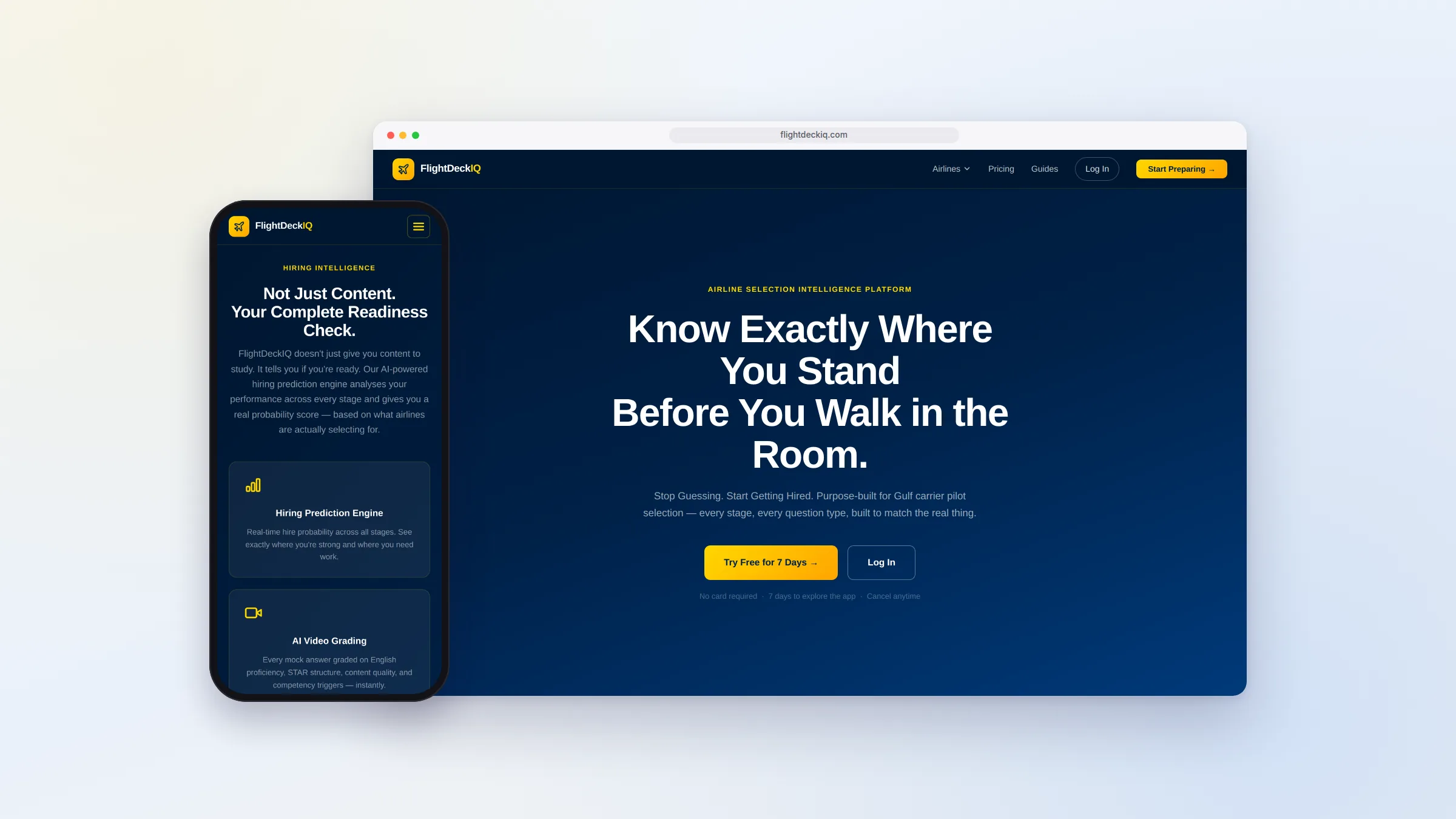
One account covers one airline and every stage of its process in the order it happens.
Flight Deck IQ is a web platform for commercial pilots who have an assessment day booked with a major airline and want to walk in having already sat every part of it.
ZingZee built the product and runs it.
Selection at a major carrier has become a specialist exam in its own right, and the people who fail it are rarely short of flying ability.
What the platform covers
Two airline modules today, one for a Gulf long-haul carrier and one for a new Middle East carrier, each following that airline's own stages.
Over 500 practice questions in the first module, with air law and aircraft type banks for the Boeing 777, Airbus A350 and Airbus A380, and Boeing 787 exercise profiles in the second.
Seven aptitude test simulators covering manual handling, spatial orientation, short-term memory, multitasking, mathematical reasoning, abstract reasoning and a dual-task screen.
A video interview simulator that grades a recorded answer for language proficiency and for the structure the airline's interviewers are looking for.
A readiness score, the Hiring Prediction Engine, that reads results across every stage and shows which phase needs more work.
Question banks updated from 2,711 verified candidate reports, so the content follows the live process and no longer relies on a document from a previous cycle.
The challenge
A major airline's pilot selection runs over several stages and several months, and none of it is taught in flight training.
Each airline gets its own module that mirrors that airline's selection process stage by stage, from the online psychometric screen to the aircraft type exam. A candidate pays once, works through six phases in order and watches a readiness score move as their results come in.
Coaches who work in this market put the first-attempt failure rate among qualified applicants at more than half, and give the same reasons every time: the candidate prepared for the wrong thing, met the test format for the first time on the day, or gave the panel a good answer in a shape the scoring sheet could not mark.
Each stage has its own format, its own clock and its own pass mark. The candidate is usually an experienced first officer or captain applying from another carrier, often with a family decision resting on the outcome. The cost of learning the process on the day is a rejection and a waiting period before the next application.
The stages of an airline assessment
- The online screen
- After the application sift, the candidate sits an online psychometric battery at home: an abstract reasoning test of 20 to 30 pattern questions against a tight clock, a personality inventory of over 100 statements scored against the airline's competency model, and a situational judgement test built around crew resource management scenarios. A recorded video interview follows, answered to a camera in one take and scored, often automatically, on language proficiency and on how the answer is organised.
- The cognitive battery
- Candidates who pass the screen are called to an assessment centre, and the first block is a computer-based aptitude battery lasting two to three hours. A psychomotor tracking task asks the candidate to hold a marker on a moving target for several minutes. A spatial orientation task shows an instrument reading and a compass rose and asks for the aircraft's position relative to a beacon. A short-term memory task reads out sequences of speeds, headings, altitudes and frequencies and asks for them back after a delay. A multitasking task runs tracking, arithmetic and a monitoring grid at once. Each test has a fixed duration, a fixed number of items and a benchmark drawn from previous cohorts.
- The competency interview
- A panel of two, usually a training captain and a recruiter, runs a competency-based interview of 45 to 60 minutes. Every answer is scored against a competency framework, and the panel marks the presence of evidence in a set structure: the situation, the candidate's own action and the outcome. An answer that wanders, or that describes what the crew did rather than what the candidate did, scores low however good the story.
- The group exercise
- Four to eight candidates are given a task or a discussion topic and observed by assessors who score behaviour rather than the answer: whether the candidate listens, holds a position under challenge and gives way when the evidence goes against them. Dominating the room and staying silent both fail.
- The simulator check
- Many carriers finish with a 45 to 90 minute simulator session, flown with another candidate as the second crew member. The profile is standard: a departure, raw-data handling, an approach and a non-normal event, scored on handling and on how the two candidates work as a crew.
- The technical exam
- Some airlines add a written exam on air law and on the aircraft type before the offer is made.
The gaps in generic preparation
Most pilots prepare with a general aptitude app, an interview guide and a few hours with a coach. A general aptitude app tests reasoning at a comfortable pace with generic content, so the first sight of the real memory test or the real multitasking screen is on the day, with the clock already running, and the first attempt is spent learning the controls while the score is being recorded.
The interview is rehearsed, where it is rehearsed at all, in the candidate's head or across a table with a friend, and neither reproduces the camera, the preparation window or the fixed scoring structure. A captain with 8,000 hours assumes the interview will go the way line checks go, and finds a scoring sheet that gives no credit for seniority. The third gap is content: selection processes change between cycles, and a candidate working from a forum post from a previous year can walk in prepared for a stage the airline dropped.
The cost to the candidate
- 01
Interview answers are marked on structure and personal evidence, and a good story delivered in the wrong shape is scored as a poor answer.
- 02
Preparation is bought stage by stage from separate providers, at a combined cost that can pass EUR 1,000 for one application, with nobody seeing the whole picture.
- 03
No provider shows the candidate a single measure of readiness, so the decision to book the flight to the assessment centre is made on a feeling.
- 04
A rejection at most major carriers carries a waiting period of six to twelve months before the candidate can apply again, and a second failure is usually final.
A candidate leaves the platform with a readiness score for the chosen airline and a record of every attempt behind it.
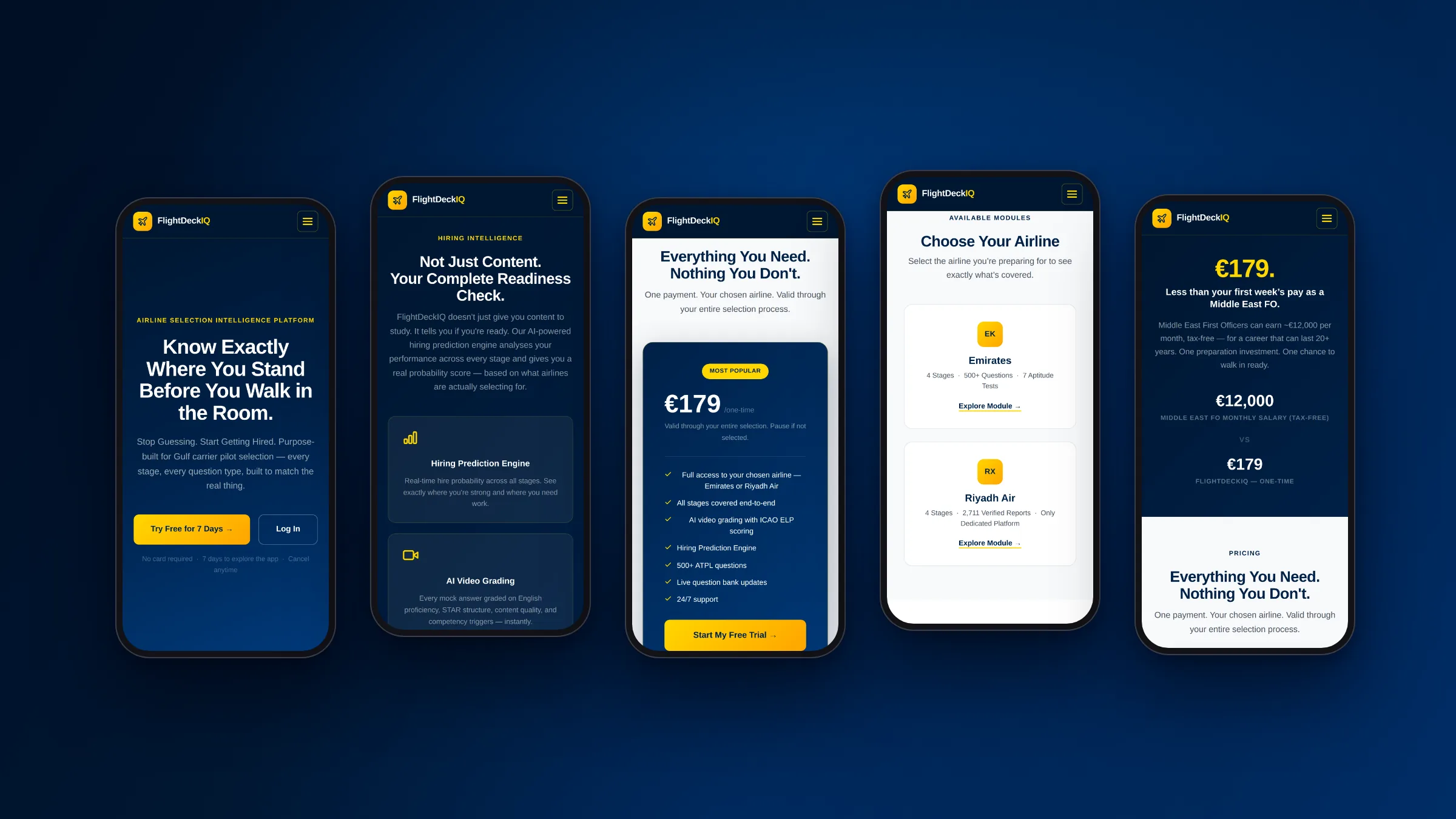
Two airline modules today, one for a Gulf long-haul carrier and one for a new Middle East carrier, each following that airline's own stages.
The solution
Flight Deck IQ puts the whole selection process for one airline into one account.
The candidate chooses the airline, and the platform lays out that airline's stages in the order they happen, with the study material and the practice tests for each. Everything runs in the browser, including the simulators, so a candidate can practise on a laptop in a crew hotel between duties. The candidate works one path in the order the airline will test it, with no programme to assemble from six sources.
Inside the platform
Airline modules
Each module is built from that airline's own process. The first covers a psychometric and video screen, a competency-based interview, an aptitude and technical battery, and a type and air law exam; the second covers an AI video screen, a psychometric battery, a panel interview and a type-specific simulator profile. A candidate applying to the second airline is never asked to study the first airline's type banks.
Phases one to six
The study path steps from foundation e-learning through each assessment stage to a final exam-realistic mock, with progress tracked per phase. The candidate always knows which stage is next and which one still needs work.
Interview practice on camera
A bank of HR and competency-based questions with model answers, and a video simulator that records the candidate's answer and grades it on the six ICAO English proficiency dimensions and on the structure the airline's interviewers score against. An answer that would have scored low with the panel scores low here first, with the missing element named.
Hiring Prediction Engine
A readiness score that reads performance across every stage and returns a hire probability against airline selection benchmarks, with the weak stage flagged. The candidate books the flight to the assessment centre on a number.
How it is built
Every module starts from the airline's real process. ZingZee documents the airline's stages in order, the format and timing of each test and the scoring the airline applies, and the platform's stages follow that document one for one. When the airline changes a stage, the module changes with it, and a candidate never studies a stage the airline has dropped.
The two authors
The content is written by two kinds of author. One has sat on the assessor side and has been involved in writing the exams, so each test reproduces the cognitive load and the scoring logic of the original rather than its surface. That author sets the item counts, the durations and the difficulty curve for each test family, and writes the scoring rubric the video grader and the readiness score work from. The other has passed these assessments several times as a candidate, and writes the study material, the model answers and the phase notes from the seat the user is in. A phase does not go live until the candidate author has sat it end to end under the clock, so the material is scored the way the airline scores and explained the way a successful applicant would explain it.
Content refresh
Under the authored content sits a stream of candidate reports. Pilots who have been through the process report back what was tested, and the platform holds 2,711 verified reports today. Where a report shows a stage has moved, in order, duration or content, the question bank and the phase notes update, and the module carries the date of its last refresh. A candidate studying in one month is working from the process as it ran the month before.
Every completed attempt is stored against its phase and the readiness score is recomputed after each one. Accounts are paused rather than deleted when a candidate is not selected, so the record is there for the next attempt.
What was hard
Three problems took most of the engineering time, and each decided whether the platform reproduces the real test or only resembles it.
- 01
Simulator timing in the browser.
A tracking task is only a fair test if the target moves at the same rate and the input lands with the same delay on every machine, and a browser gives neither by default: frame timing drifts under load and key events queue. We run the task state on a fixed time step, render whatever frame is available, and timestamp every input from the event itself rather than from the frame it was processed in. A calibration run before each timed attempt measures dropped frames and input delay, and an attempt outside the tolerance is voided rather than scored. A score on a five-year-old laptop now means the same as a score on a new one.
- 02
Grading a video answer automatically.
Transcribing pilots from thirty countries talking about diversions and go-arounds defeated the general transcription models on the first pass, and a grade built on a wrong transcript is worse than no grade. We added an aviation vocabulary layer in front of transcription, wrote the structural grader against the assessor author's rubric, and tuned it against a calibration set the candidate author recorded and hand-graded. Every grade is shown next to its transcript, so the candidate can see what was heard as well as how it was marked.
- 03
Keeping the banks aligned with a moving process.
The airlines change their stages without notice. Every item and every phase note carries tags for the airline, the stage, the test family and the cohort of candidate reports that supports it. When the support for an item drops, it is retired from timed mode first and from practice mode once the replacement is written, so the timed mock always follows the process as it currently runs.
The results
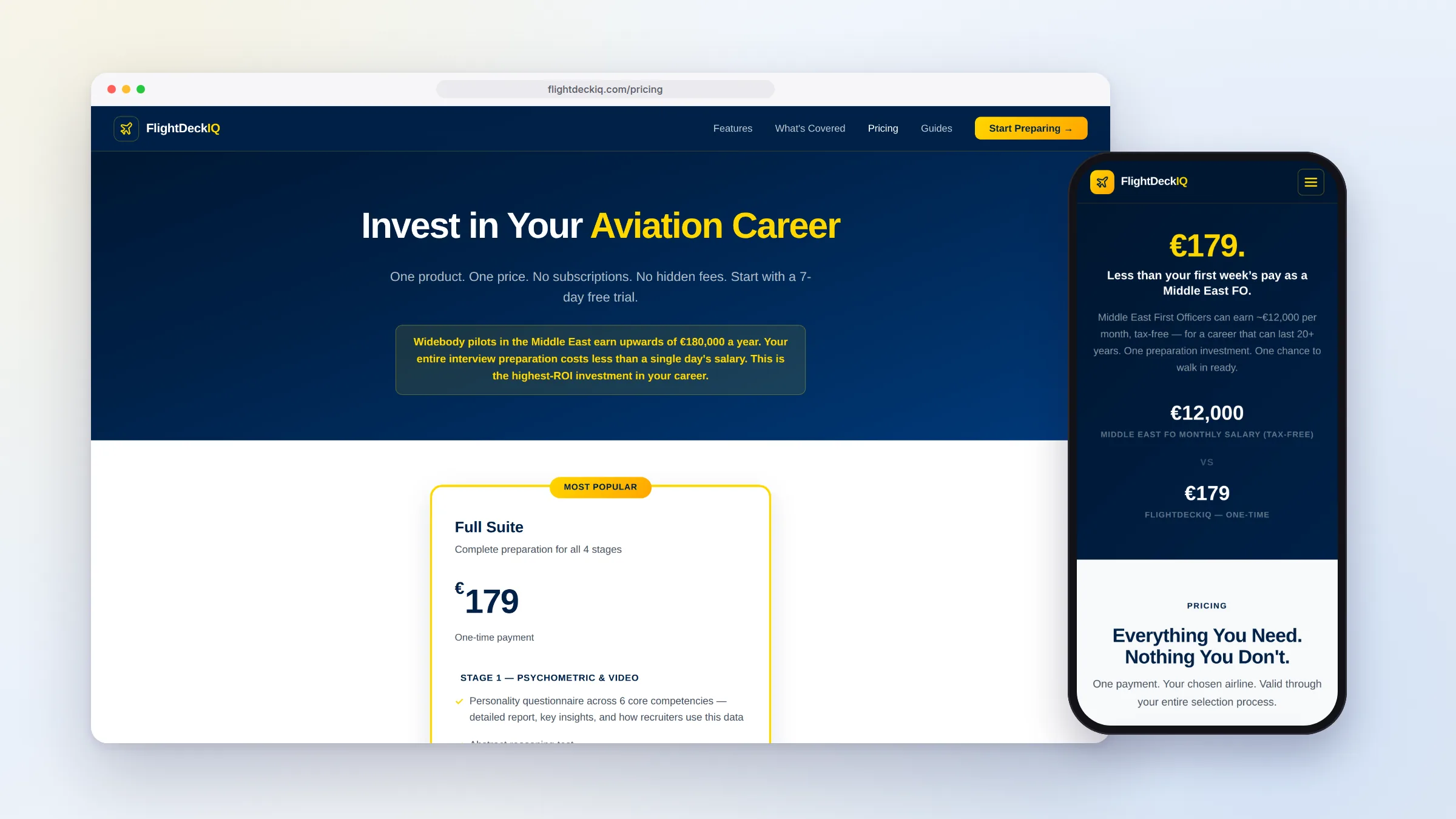
A candidate pays EUR 179 once for the full module and starts with a seven-day free trial that needs no card.
From there the module opens at phase one, and each phase carries its own e-learning, its own practice and its own timed test, in the order the airline runs the real stages.
Phases one to six
- 01Foundations. E-learning on the airline's process end to end: each stage, its format, its duration and what the assessors are scoring. The candidate starts with the whole process in view before the first stage begins.
- 02The online screen. Abstract reasoning in practice and then timed mode, the personality questionnaire mapped to the airline's six competencies, situational judgement scenarios, and the video interview simulator with the same single take the airline uses. The first one-take answer the candidate gives to a camera is a practice one.
- 03The interview. The HR and competency-based question banks with model answers, and on-camera rehearsal where each recorded answer comes back graded on language proficiency and on whether the situation, the candidate's own action and the outcome are all present and in order. By the panel, the structure is automatic and the candidate's attention is on the example.
- 04The aptitude battery. The seven simulators, each with unlimited practice runs and a timed run scored the way the airline scores it. Manual handling: a three-minute tracking task on a primary flight display. Spatial orientation: an instrument and compass task asking for the aircraft's position relative to a beacon. Short-term memory: sequence recall across speed, heading, altitude and radio frequency, with the delay stretched over attempts. Multitasking: ATC data entry, an alert grid and a tracking task at once. Mathematical reasoning: 24 fuel, speed, distance and time problems. Abstract reasoning: timed pattern completion. Dual task: the two-attempt format the second airline uses. The candidate walks into the battery having learnt every interface already, so the recorded attempt is the practised one.
- 05Technical and type. Over 500 ATPL questions, an air law bank covering the conventions the airline examines on, and type banks for the Boeing 777, Airbus A350 and Airbus A380, with Boeing 787 first officer and captain profiles in the second module. The candidate knows their weak topics by name before the written exam.
- 06The mock and the readiness score. A timed run through every stage of the module in sequence, on the airline's clock, scored as the airline scores it. The Hiring Prediction Engine reads the result alongside every earlier attempt and returns a hire probability, with the weak stage flagged and a route back to the phase that trains it. The candidate decides whether to travel, or to take another two weeks, on a score.
Progress analytics
The dashboard shows every phase with its attempts, its best score and its last score, and the readiness score at the top. Each simulator carries a trend line across attempts, each question bank shows the topics where the error rate is highest, and the video simulator keeps every recording with its grade. Support runs 24 hours a day, for a user base spread across every time zone airlines recruit from. Study time goes to the phase that is holding the score down, and the candidate can see the day it stops being the weakest one.
What is next
The next modules will add further carriers, each built from that airline's process in the same way, and the type exam banks will extend to the aircraft those carriers fly. Group exercise preparation, currently the one stage of an assessment day the platform does not rehearse, is in design as a guided scenario with scoring on the behaviours assessors watch for. A cadet path for pilots coming out of training with low hours will follow the same six-phase structure, and the candidate report stream will open to graduates of the platform so the refresh cycle shortens as the user base grows.